








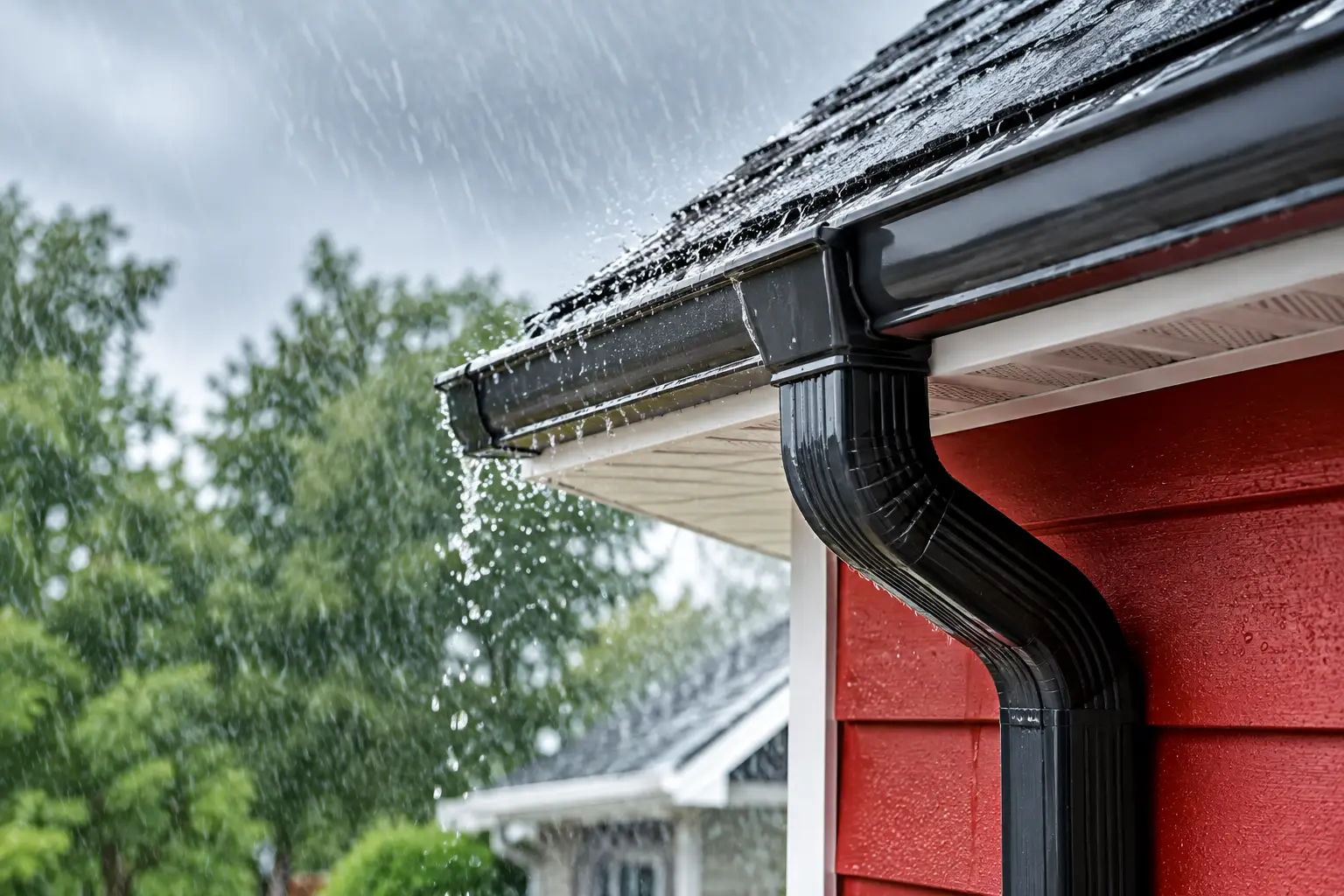
A gutter can look perfectly fine on a clear day and still fail the first time a Texas thunderstorm sends water rushing off the roof. The best gutters for heavy rain are not simply the biggest ones available. They are correctly sized, properly pitched, securely attached, and paired with enough downspouts to move water away before it can damage the roofline, siding, foundation, or landscaping.
For homes and commercial properties in Fort Worth and across DFW, gutter performance matters most during short, intense storms. A system that handles ordinary rainfall may overflow when a large roof section drains all at once. Choosing the right system starts with understanding where the water is coming from and where it needs to go.
What Makes Gutters Work in Heavy Rain?
Heavy-rain performance comes down to capacity and flow. Capacity is how much water the gutter can hold at one time. Flow is how quickly that water can reach a downspout and discharge safely away from the building. Both matter.
A steep roof, a long unbroken roof edge, or a roof valley can concentrate a surprising amount of water in one location. If the gutter is too narrow, too shallow, or poorly sloped, water can spill over the front edge. It may also back up behind the gutter, wetting fascia boards and creating conditions for rot.
The gutter itself is only one part of the system. Downspouts, outlet size, gutter hangers, end caps, splash blocks, and underground drains all affect whether water stays controlled during a storm. A larger gutter with undersized or too few downspouts can still overflow.
Best Gutters for Heavy Rain: Start With Size
For many homes, a 6-inch K-style gutter is the practical choice for heavy rain. It carries more water than the common 5-inch profile while maintaining a clean appearance that works well with most rooflines. This added capacity can make a meaningful difference on homes with broad roof planes, multiple valleys, or steep pitches.
Five-inch gutters are not automatically a poor choice. They can perform well on smaller, simpler roofs with appropriate downspout placement. But when a property has recurring overflow at valleys or at the ends of long gutter runs, moving up to 6 inches is often more effective than repeatedly cleaning or patching the existing system.
Seven-inch gutters are typically considered for very large homes, commercial buildings, or roof areas that collect substantial runoff. They are more visible and may cost more, so they are not necessary for every property. The right size should be based on the roof’s drainage area and layout, not on a one-size-fits-all recommendation.
K-Style Gutters Are Usually the Best All-Around Option
K-style gutters are the most common choice for residential properties because they hold more water than similarly sized half-round gutters. Their flat back also allows them to mount securely against the fascia. For heavy rain, that extra capacity is useful without making the system look oversized.
Half-round gutters can be a good fit for historic homes or properties with a specific architectural style. They have a traditional appearance and allow debris to move through smoothly in some situations. However, they generally carry less water at comparable widths, and their installation can be more specialized. For a home that regularly sees fast, heavy runoff, K-style gutters are usually the more practical choice.
Downspouts Matter as Much as the Gutter
Water can only leave a gutter as quickly as the downspouts allow. A heavy-rain system needs downspouts sized and positioned to match the water entering each section of gutter.
Larger 3-by-4-inch rectangular downspouts move considerably more water than smaller 2-by-3-inch versions. They are especially helpful below roof valleys and on long gutter runs. Adding a downspout can also solve an overflow problem when the gutter itself is still in good condition.
Placement is just as important. A downspout at the far end of a long run may not be enough when a valley dumps water near the middle. In those cases, water may race past the outlet during a hard downpour. An additional outlet closer to the concentrated flow can prevent water from climbing over the gutter edge.
Discharge should not stop at the bottom elbow. Downspouts need extensions, splash blocks, or properly designed drainage connections that direct water away from the foundation. If water pools next to the home, the gutter has moved the problem rather than solved it.
Material Choices and the Case for Seamless Gutters
Aluminum is the most common gutter material for good reason. It is lightweight, resistant to rust, available in many colors, and suitable for most residential applications. Quality aluminum gutters can provide dependable service when they are installed with proper support and maintained over time.
Steel is stronger but can eventually rust if its protective finish is scratched or worn. Copper offers a distinctive appearance and long service life, but its cost makes it a specialized choice rather than a standard heavy-rain solution. Vinyl is inexpensive, but it can become brittle, sag, or separate at joints under heat and weather exposure. It is generally not the first choice for homeowners seeking a long-term system.
Seamless aluminum gutters are often worth considering because they have fewer joints along each run. Fewer joints mean fewer common leak points and a cleaner finished appearance. They still have seams at corners, outlets, and end caps, so they are not maintenance-free. But compared with sectional gutters, seamless systems reduce the number of places where age and movement can create leaks.
Installation Details That Prevent Overflow and Damage
Even the best gutter profile will not perform well if it is installed incorrectly. Gutters should have a controlled slope toward the downspouts - enough to keep water moving, but not so much that the system looks uneven from the ground.
The front edge must also be positioned correctly below the roof’s drip edge. If water runs behind the gutter instead of into it, fascia boards can stay wet even when the gutter is clear. This is a common reason for peeling paint, soft wood, and hidden water damage around the roofline.
Strong hangers are another necessity. Heavy rainfall adds weight quickly, especially when leaves or roofing granules are present. Loose or widely spaced hangers allow the gutter to sag, creating low spots where water stands. Those low spots collect debris, encourage corrosion at seams, and reduce the system’s usable capacity.
A careful installation should also account for roof valleys. These are high-volume drainage points, not ordinary stretches of roof edge. Depending on the situation, a wider gutter, a larger downspout, a valley splash guard, or a revised downspout layout may be needed to keep runoff under control.
Are Gutter Guards Worth It for Heavy Rain?
Gutter guards can reduce the amount of leaves, twigs, and roof debris entering the system. That can help preserve flow during storms, especially on properties with mature trees. But guards do not increase gutter capacity, and they do not correct undersized gutters, poor drainage, or inadequate downspouts.
Some guard styles can shed water in very heavy rain if they are poorly matched to the roof pitch or installed incorrectly. Others may collect debris on top and require periodic brushing. The best approach is to treat guards as a maintenance tool, not a cure for every gutter problem.
If a gutter system is overflowing, the first step is to determine why. The cause may be a clog, but it may also be poor slope, a buried downspout blockage, a roof valley that overwhelms the existing system, or fascia damage that has changed the gutter’s position.
When Repair Is Enough and When Replacement Makes Sense
A targeted repair may be enough when the gutters are structurally sound but have a loose hanger, leaking end cap, disconnected downspout, or small drainage issue. Cleaning and resealing can also extend the life of a system that is otherwise properly sized and securely installed.
Replacement becomes more sensible when gutters sag repeatedly, show widespread seam failure, have corroded areas, pull away from deteriorated fascia, or routinely overflow despite being clean. If roof repairs, fascia replacement, or exterior painting are already planned, it can be a practical time to address the entire roofline together.
Salter Exteriors evaluates gutters as part of the broader exterior system, including the roof edge, fascia, soffit, siding, and drainage path. That helps identify the actual source of water intrusion instead of recommending a larger gutter before the underlying issue is understood.
A gutter system should be judged during the kind of storm it is meant to handle. If you see water spilling over the edge, running behind the gutter, staining exterior walls, or pooling near the foundation, take photos when it is safe to do so. Those details can help a qualified contractor identify whether a simple repair, added downspout, or properly sized replacement will protect the property when the next hard rain arrives.
Questions about your gutters? Call or text Aaron at 972-246-7448.
Thanks for reading,
Aaron
Salter Exteriors, Fort Worth, TX, serving Tarrant County and North Texas · Call or text 972-246-7448
Related services and service areas
Need help with what this article covers? Salter Exteriors Roofing & Remodeling handles gutter replacement, leaf guard systems and gutter cleaning. See our local pages for Fort Worth, Arlington and Burleson, plus the rest of our North Texas service areas. Text or call 972-246-7448 to request a free estimate.