








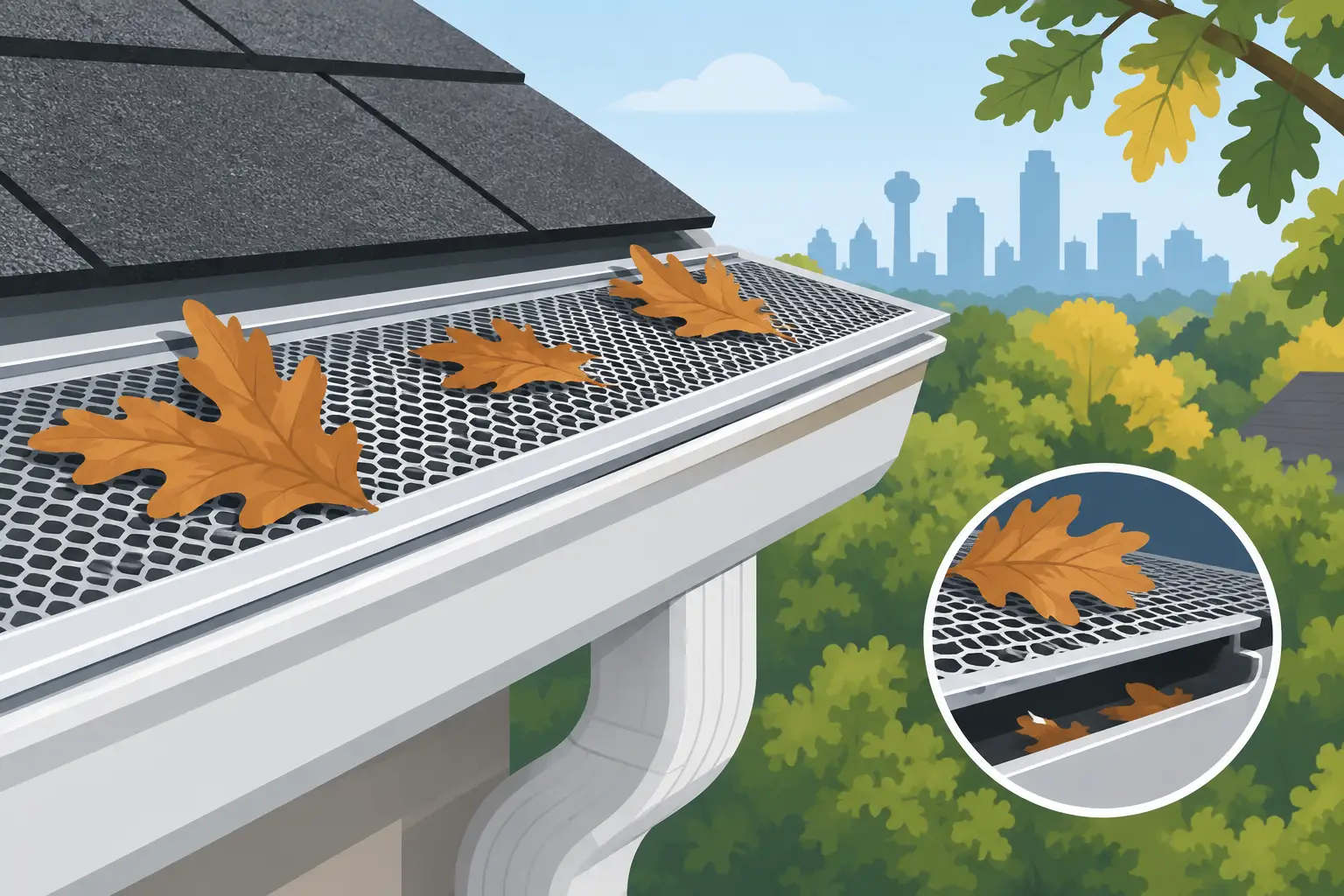
Oak leaves rarely fall neatly into a bag. They curl, cling to shingles, settle in roof valleys, and collect at gutter openings after the first hard wind. That is why choosing gutter guards for oak leaves takes more than picking the product with the strongest marketing claim. North Texas homes need a system that can manage leaf drop, spring debris, sudden downpours, and the occasional acorn without restricting drainage.
A quality guard can greatly reduce gutter cleaning, but it is not a promise that gutters will never need attention again. The right choice depends on your roof pitch, gutter condition, surrounding trees, and the way water moves across your roof. A careful inspection before installation helps prevent spending money on a guard that is not suited to the home.
Why Oak Leaves Challenge Gutter Systems
Oak leaves create a different problem than large, flat leaves from a maple or sycamore. Many oak leaves are narrow and dry, so they can slide toward a guard's openings instead of simply resting on top. When wet, they can mat together along the front edge of a gutter guard. Live oaks can also shed leaves gradually over long stretches of the year rather than during one short fall cleanup season.
Then there are the extras: small twigs, pollen, seed pods, acorns, and roof grit. In Fort Worth, Arlington, Burleson, and surrounding communities, wind-driven rain can push that material into places it would not normally reach. If a gutter guard has wide openings or a poorly designed front edge, debris may still enter the gutter. If the openings are too fine for the roof and rainfall conditions, water may overshoot during a heavy storm.
The goal is not to block every speck of debris. It is to keep enough debris out that water can travel freely to the downspouts and away from the foundation.
The Best Gutter Guard Styles for Oak Leaves
No single style is right for every house. A guard that performs well on a low-slope roof with standard five-inch gutters may not be the best fit for a steep roof that receives concentrated runoff into a valley.
Fine Micro-Mesh Guards
Fine stainless-steel micro-mesh guards are often a strong option for homes surrounded by oak trees. The small openings keep most leaves, pine needles, roof grit, and insect debris from entering the gutter while allowing water through the surface. Because oak leaves stay above the mesh, wind and normal rainfall can move much of the debris away over time.
The trade-off is quality and installation. Lower-grade mesh can sag, separate from its frame, or clog with fine pollen and shingle grit. A well-built system needs a rigid support frame and a secure fit at both the gutter edge and roof side. It should also be installed to support proper water flow rather than simply tucked beneath shingles.
Raised Mesh or Perforated Aluminum Guards
Perforated aluminum guards and raised mesh systems can work well where leaf debris is moderate and homeowners want a durable, straightforward option. Their openings are generally larger than micro-mesh, so they may pass heavy rain more easily. They also tend to be easier to inspect and clean if debris accumulates.
For oak-heavy properties, opening size matters. Large holes can allow broken leaf pieces, seeds, and roof granules into the gutter. These guards may be a sensible value option, but they need to be matched to the tree coverage around the home.
Surface-Tension or Hooded Guards
Hooded guards use a curved front edge designed to direct water into the gutter while leaves move over the top. When properly sized and installed, they can handle larger leaves effectively and offer a clean appearance from the ground.
Their performance depends heavily on roof runoff and installation angle. Fast water coming off a steep roof or a roof valley can sometimes run past the opening in a hard storm. Small oak debris may also gather at the front lip. These systems are worth considering, but they should be evaluated at the specific areas where your roof sheds the most water.
Brush and Foam Inserts
Brush and foam inserts are usually the least effective long-term choice for oak leaves. They may appear convenient because they sit inside the gutter, but debris can lodge in and around the material. Once leaves, acorns, and sediment settle into the insert, water flow can become restricted and cleanup can be more difficult than cleaning an open gutter.
They may provide a short-term improvement in a low-debris location, but they are not usually the first recommendation for a North Texas home with mature oak coverage.
A Guard Cannot Fix an Undersized or Damaged Gutter
A leaf guard is only one part of the drainage system. If gutters are pulling away from the fascia, sloping the wrong direction, rusted through, or undersized for the roof area, adding a guard will not solve the underlying problem. Water can still spill over the front edge, back up near the roofline, or overflow at downspouts.
Before installation, check that the gutter is securely fastened, properly pitched, and free of standing water. Downspouts should be clear and sized to handle the amount of runoff coming from the roof. Areas below roof valleys may need larger gutters, additional downspouts, or splash management because they receive more water than the rest of the system.
Fascia condition matters, too. A gutter attached to softened or rotted fascia is not a reliable base for any guard system. Addressing damaged fascia and soffit before the guard installation protects the work and helps avoid a second project later.
What to Look for During an Estimate
Homeowners should expect more than a quick measurement and a product pitch. An honest gutter guard recommendation starts with looking at the roofline, tree coverage, existing gutters, and known overflow areas. It should include a plain explanation of what the selected guard can do and where routine maintenance may still be needed.
Ask how the system performs during heavy rain, whether it is fastened in a way that protects the roof, and how it will work around valleys and inside corners. Ask whether the installer will clean the gutters before installation and repair loose hangers or damaged sections first. A good proposal should also identify whether a gutter replacement makes more sense than placing a premium guard over aging material.
It is reasonable to ask about warranties, but read beyond the headline. Some warranties cover material defects but not clogs, labor, storm damage, or cleaning. The practical value of a guard comes from sound design, careful installation, and a contractor who is available if a concern develops.
Maintenance Still Has a Place
Even the best gutter guards for oak leaves need occasional visual checks. After a major windstorm or the heaviest part of leaf drop, look from the ground for debris collecting along the roof edge, water spilling over gutters, or staining on the fascia. If you see a problem, address it before repeated overflow damages trim, siding, landscaping, or the foundation area.
Most homes with quality mesh or properly fitted metal guards need far less hands-on cleaning than open gutters. Still, roof valleys, low-slope sections, and areas beneath dense branches may require periodic debris removal. Keeping branches trimmed back from the roof also reduces the amount of material that reaches the drainage system in the first place.
Never climb a ladder or walk on a roof if you are not comfortable doing so. A professional inspection can identify clogged downspouts, loose gutter sections, roof damage, and hidden fascia deterioration without turning a simple maintenance question into a safety risk.
Choose for Your Home, Not the Sales Pitch
The lowest-priced insert may not hold up under steady oak debris, while the most expensive guard is not automatically the right answer for every roof. The best system is one that fits the gutter size, handles the water volume your roof produces, and can be installed without creating problems at the shingles, fascia, or valleys.
For homeowners who need a complete look at gutters, roof drainage, and connected exterior repairs, Salter Exteriors can help evaluate the system as a whole. A clear inspection gives you room to make the right decision without pressure, whether that means guards, gutter repairs, replacement, or a simpler maintenance plan.
A gutter guard should make ownership easier, not create another item to worry about. Start with the condition of the roofline and gutters, choose a design suited to your oak coverage, and make sure water has a clear path away from the home when North Texas weather turns fast.
Questions about your gutters? Call or text Aaron at 972-246-7448.
Thanks for reading,
Aaron
Salter Exteriors, Fort Worth, TX, serving Tarrant County and North Texas · Call or text 972-246-7448
Related services and service areas
Need help with what this article covers? Salter Exteriors Roofing & Remodeling handles gutter replacement, leaf guard systems and gutter cleaning. See our local pages for Fort Worth, Arlington and Burleson, plus the rest of our North Texas service areas. Text or call 972-246-7448 to request a free estimate.