








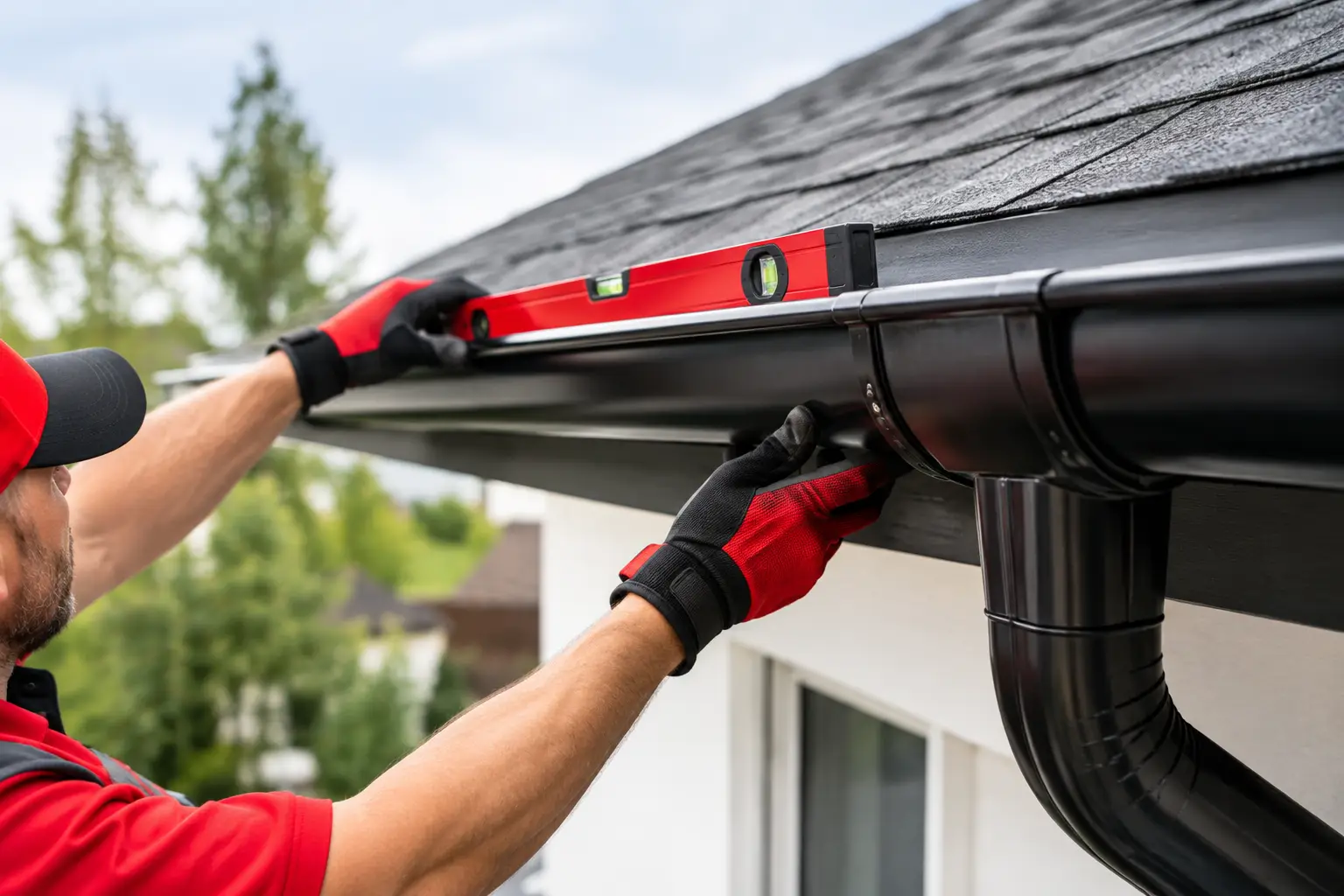
Water should not remain in a gutter long after a Fort Worth rainstorm has passed. A small amount near an outlet can be normal while the system finishes draining, but persistent puddles, overflowing corners, and water marks on fascia often point to a drainage problem. Gutter slope adjustment is one possible solution, but it only works when the gutter itself is in sound condition and the real cause has been identified.
A properly installed gutter system protects more than the roof edge. It directs water away from the fascia, soffit, siding, foundation, landscaping, walkways, and entry areas. When water cannot move toward the downspouts, it adds weight to the gutter and can gradually create more extensive exterior repairs.
What Gutter Slope Is Supposed to Do
Gutters are not installed level. They need a subtle pitch toward each downspout so rainwater flows out instead of collecting in the channel. The drop is slight enough that it is usually not noticeable from the ground, but it makes a major difference during a heavy rain.
As a general guideline, installers often pitch gutters about 1/4 inch for every 10 feet of gutter run. Long runs may require more than one downspout or a high point in the middle that slopes in both directions. The right layout depends on roof area, gutter length, roof valleys, local rainfall patterns, and where downspouts can safely discharge water.
Too little slope can leave standing water and debris behind. Too much slope can make the gutter look uneven and may cause water to rush past an outlet during intense rainfall. The goal is controlled drainage, not the steepest possible angle.
Signs You May Need a Gutter Slope Adjustment
Standing water is the most obvious sign, but it is not the only one. Homeowners may notice a gutter that overflows at the middle of a run even when the downspout appears open. They may see debris accumulating in one section, dark staining along the gutter face, or fastener holes pulling loose as the extra water weight stresses the system.
Inside the property, the warning signs can be more expensive. Water stains at the eaves, soft fascia boards, peeling exterior paint, soffit damage, and moisture near a foundation can all be connected to poor water control. These conditions do not automatically mean the gutter pitch is wrong, but they deserve a closer inspection.
For commercial properties, the issue may appear along storefront awnings, low-slope roof edges, breezeways, or areas where pedestrians enter the building. Water spilling over gutters can create slip hazards and interrupt normal operations, especially during repeated storms.
A Gutter Slope Adjustment Is Not Always the Answer
It is easy to assume a gutter that overflows needs to be re-pitched. Sometimes it does. Just as often, the system is dealing with a different problem that adjustment alone will not correct.
Clogged outlets and downspouts are a common cause. Leaves, roof granules, small twigs, and nesting material can restrict water at the exact point where it needs to exit. A gutter may also be undersized for the roof area, especially below a valley where a large volume of water concentrates in one location.
Improper hanger spacing can allow a gutter to sag between supports, creating low spots even if the overall slope is correct. Loose fasteners, separated seams, bent sections, and failing fascia can cause similar problems. On older homes, the fascia itself may have deteriorated enough that the gutter cannot hold a reliable line until the wood is repaired.
Downspout discharge matters, too. A well-pitched gutter will still contribute to foundation moisture issues if its downspouts empty too close to the structure or drain into a blocked underground line. A thorough assessment follows the entire path of the water, from the roof surface to the final discharge point.
How Professionals Diagnose Drainage Problems
A proper inspection begins with the roof edge, not just the visible gutter face. The contractor looks for roof valleys that direct concentrated water into one small area, shingle edge issues, damaged drip edge, and signs that water is getting behind the gutter. These details help determine whether the issue started on the roof or within the gutter system.
Next, the gutter run is checked for sagging, separation, corrosion, seam failure, and alignment. A level or laser measurement can confirm whether the gutter has the correct fall toward the outlet. Water testing may also be useful, particularly when a problem only occurs during heavy rainfall.
The downspouts, elbows, outlet openings, and extensions should be inspected for restrictions and poor routing. If fascia, soffit, or siding has already been affected, the inspection should document that damage as well. Addressing the gutter without repairing the damaged materials can leave the property vulnerable to ongoing moisture intrusion.
Clear photos and a straightforward explanation are especially valuable after hail or wind events. Storm damage can loosen hangers, dent gutters, damage fascia, or shift sections out of alignment. Documentation helps property owners understand what needs attention and can support a more complete insurance claim when covered storm damage is present.
What a Proper Adjustment Involves
A gutter slope adjustment is more involved than bending a section upward by hand. The crew first establishes the correct high and low points based on the downspout location and gutter length. Then they carefully loosen or remove hangers, reset the gutter line, and secure it to sound backing material.
If the fascia is soft, split, or rotted, that repair should come first. Refastening a gutter to compromised wood may improve its appearance briefly, but it will not provide a lasting solution. Seams, end caps, outlets, and corners should also be checked and resealed as needed while the system is being adjusted.
In some cases, the best recommendation is to add a downspout, resize a section of gutter, or replace damaged portions rather than force an existing system to perform beyond its design. This is particularly common where roof valleys send heavy water flow into a short gutter run. Honest recommendations should match the condition of the home and the way water actually moves across the roof.
Why Prompt Repairs Protect More Than Gutters
A gutter holding water can become surprisingly heavy. Over time, that weight pulls against hangers and fascia boards, creating gaps where water can run behind the system. Once moisture reaches wood components, repairs can extend to fascia, soffit, trim, paint, and sometimes interior areas near the roofline.
Poor drainage can also wash out mulch, erode soil, stain masonry, and direct water toward the foundation. In North Texas, sudden downpours make a small drainage weakness more noticeable because the system has to manage a large amount of water in a short period.
The good news is that not every issue requires full gutter replacement. If the gutters are structurally sound, a targeted adjustment and repair may restore proper drainage. If the metal is badly dented, corroded, undersized, or repeatedly pulling away from failing fascia, replacement may offer better long-term value.
When to Schedule an Inspection
Consider having the gutters checked after a storm, after seeing overflow during rain, or when you notice staining or deteriorating wood around the eaves. It is also wise to inspect them before exterior painting, roof replacement, or major property maintenance work. Coordinating connected repairs helps ensure the roof edge, drainage system, fascia, and finish materials work together.
For homeowners and property managers, the practical goal is simple: water should leave the roof, move through the gutters, and discharge away from the building without damaging anything along the way. A careful inspection can determine whether a gutter slope adjustment is the right fix or whether a different repair will protect the property more effectively.
Questions about your gutters? Call or text Aaron at 972-246-7448.
Thanks for reading,
Aaron
Salter Exteriors, Fort Worth, TX, serving Tarrant County and North Texas · Call or text 972-246-7448
Related services and service areas
Need help with what this article covers? Salter Exteriors Roofing & Remodeling handles gutter replacement, leaf guard systems and gutter cleaning. See our local pages for Fort Worth, Arlington and Burleson, plus the rest of our North Texas service areas. Text or call 972-246-7448 to request a free estimate.