What is commercial roof leak repair?
It is finding the place water gets in, and fixing that detail, so the same storm does not bring it back. On a business that might be a seam weld, a pipe boot, a curb corner, a drain, or a wall flashing.
It is not painting the ceiling tile. It is not a thick coat of sealant over a stain you can see from the parking lot. A coating can be part of a plan after the leak is found. It is not how you find it.
A straight commercial repair also writes down the cause. The next person on the roof — or the manufacturer, if a warranty is in play — should be able to see what failed and what was done.
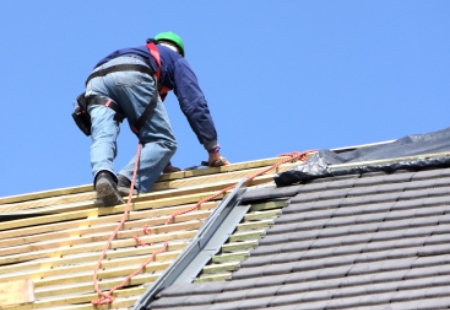
Naming that entry point takes someone on the roof. Have Salter Exteriors inspect it before anyone sells you a patch.
What are the two most common commercial roofs?
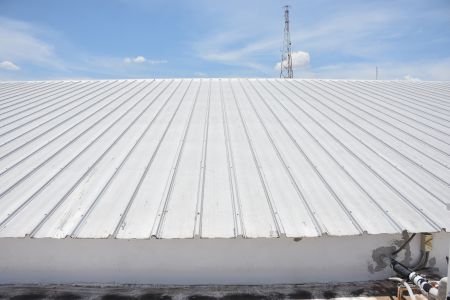
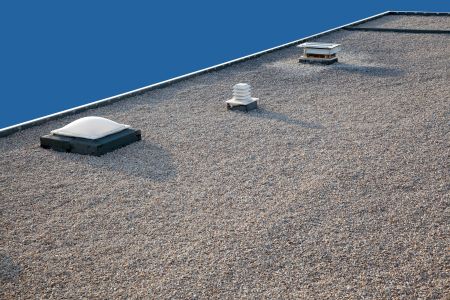
Around Fort Worth, the two we see most are flat membrane roofs and metal roofs. Flat, in this trade, means low-slope: TPO, PVC, or EPDM. Metal means standing seam or screw-down panels on shops, warehouses, and canopies.
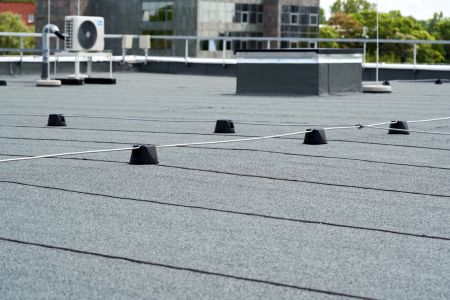
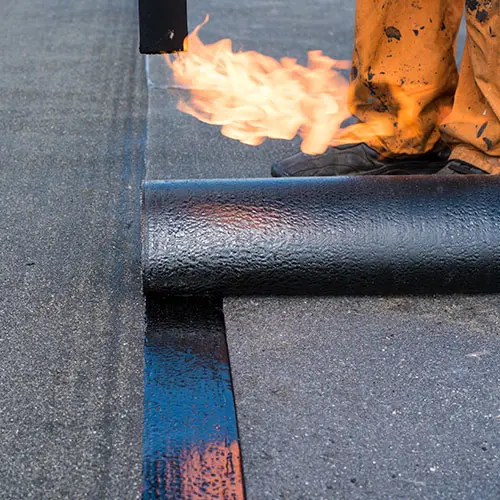
A third system is still on a lot of older buildings: modified bitumen, the dark granulated sheets rolled on in laps. It leaks differently from the other two, which is why this guide gives it the same attention.
From the street, people mix them up. A white flat roof, a silver metal roof, and a dark rolled roof do not take the same repair. Using house-roof habits — a dab of roof cement, a few nails — makes all three worse.
If you are not sure which roof you have, that is the first thing an inspection answers. Salter Exteriors will identify it and tell you what that means for the leak.
How do I track a flat roof leak?
Start inside. Put a piece of tape on the stain or set a bucket where it drips. Write down whether water shows up during the rain or after it stops. A late leak often means the roof held a pond, then let it through.
Then think uphill, not straight up. On a flat roof the membrane is a continuous sheet. A pinhole at a weld, a drain, or an equipment curb can travel sideways under the sheet before it drops. The wet tile is the exit.
Useful clues from a safe spot: stains that line up with a rooftop unit, a wall that is wet only under the parapet, or water that appears whenever a certain drain is slow. None of those clues are the repair.
Do not flood the roof with a hose to “test” it. You can drive water into a dry area, overload a soft spot, and still not prove which seam failed.
Tracking a flat roof leak ends at the ceiling for a building owner. The rest is a careful walk of the seams, drains, and curbs. Have Salter Exteriors inspect it.
How do I track a leak on modified bitumen?
Modified bitumen is those dark, grainy rolls. Water that gets through an open lap can travel between the plies, so the drip inside may sit nowhere near the failed seam.
What owners can sometimes see, without climbing, is a lifted edge at a wall, granules in a gutter, or a bald shiny spot where water has been sitting. Blisters that have split are a stronger sign than blisters that are still closed.
Pitch pockets — the little dams poured around a cluster of pipes — dry out and crack. That is a common, local leak. It is also easy to smear full of coating and not actually fix.
An open lap needs a proper patch, or a straight answer that the sheet is used up. Have Salter Exteriors inspect it and tell you which one you are looking at.
What are the early signs of a commercial roof leak?
You do not need a waterfall. Early signs are quieter, and they are worth a call before the deck gets soft.
- A ceiling stain, or a drip that starts after the rain has already stopped
- Soft or darkened drywall high on a wall
- Water still ponding on a low roof two days later
- Mineral granules in a gutter or scupper — common with modified bitumen
- Rust streaks at metal fasteners, boots, or a skylight
- A musty top floor after a storm, even if you cannot find the drip yet
Any one of these is a reason to have Salter Exteriors inspect the roof. Waiting for a second storm is how a repair turns into a replacement.
Can I repair a commercial roof leak myself?
For a business roof, almost never the leak itself. The fall risk is real. A patch in the wrong place can void a manufacturer warranty. And a small split, smeared with the wrong cement, often becomes a bigger split.
What you can do today: move people and inventory, catch the water, photograph the stain, and keep everyone off the roof. If water is coming in hard, say so when you call. Temporary protection, including a tarp, is a conversation after someone understands the roof — not a first guess in the rain.
Store-bought roof cement and elastomeric coating sold as “leak repair” are the products we end up removing. They hide the lap we needed to see.
Have Salter Exteriors inspect it. The visit is free, there is no high-pressure pitch, and you will know whether this is a commercial repair or something that should not be patched.
When is a commercial repair enough?
Repair is the honest answer when the rest of the roof is still sound and the leak is a detail: one boot, one curb, one open lap, one drain. That is a lot of the calls we take.
Replacement belongs on the table when the sheet is brittle across the field, patches would cover more roof than they save, ponding has softened the deck, or metal panels are thin at the fasteners and not just at one flashing.
Nobody can make that call from a ceiling photo. A roof that “needs replacing” in a phone quote, before a walk, is a sales script. A roof that “just needs a bottle of coating,” before a walk, is the other script.
Have Salter Exteriors inspect it and say which of those two you actually have. You should hear the reason, not just the price.
Who should inspect a commercial roof leak in Fort Worth?
A local crew that will get on the roof, name the system, and separate a detail repair from a roof that is done. Salter Exteriors does that work for businesses in Fort Worth, Arlington, Burleson, and the rest of the North Texas cities we serve.
We are licensed and insured, BBB accredited since 2016 with an A+ rating, and we have been at this since 2014. The inspection and the estimate are free. No obligation, and no high-pressure sales — if a repair is the right job, we will say repair.
Call 972-246-7448 or ask for the inspection online. Tell us what you see inside and, if you know it, whether the roof is flat, metal, or modified bitumen. If you don’t know, that is fine. That is part of the visit.
Have Salter Exteriors inspect it. A ceiling stain is a clue. It is not a diagnosis.